

Many London business owners assume that preparing accounts and having them audited are the same thing. They are not. One is about compiling accurate financial statements for filing and tax purposes. The other is an independent examination that provides formal assurance. Understanding the difference between accounts preparation and audit helps you stay compliant, control costs and meet the expectations of banks, investors or shareholders.
Key Areas We Will Cover:
- What accounts preparation involves
- What a statutory audit entails
- Current UK audit exemption thresholds
- When accounts preparation alone is sufficient
- When an audit becomes mandatory or advisable
- How the two services work together for growing businesses
Introduction:
Accounts preparation and audit serve different purposes under UK company law. Most private limited companies need professionally prepared accounts each year. Only some require a full statutory audit. Knowing which applies to your business, and when, avoids unnecessary expense while ensuring you meet Companies House and stakeholder requirements.
What Is Accounts Preparation?
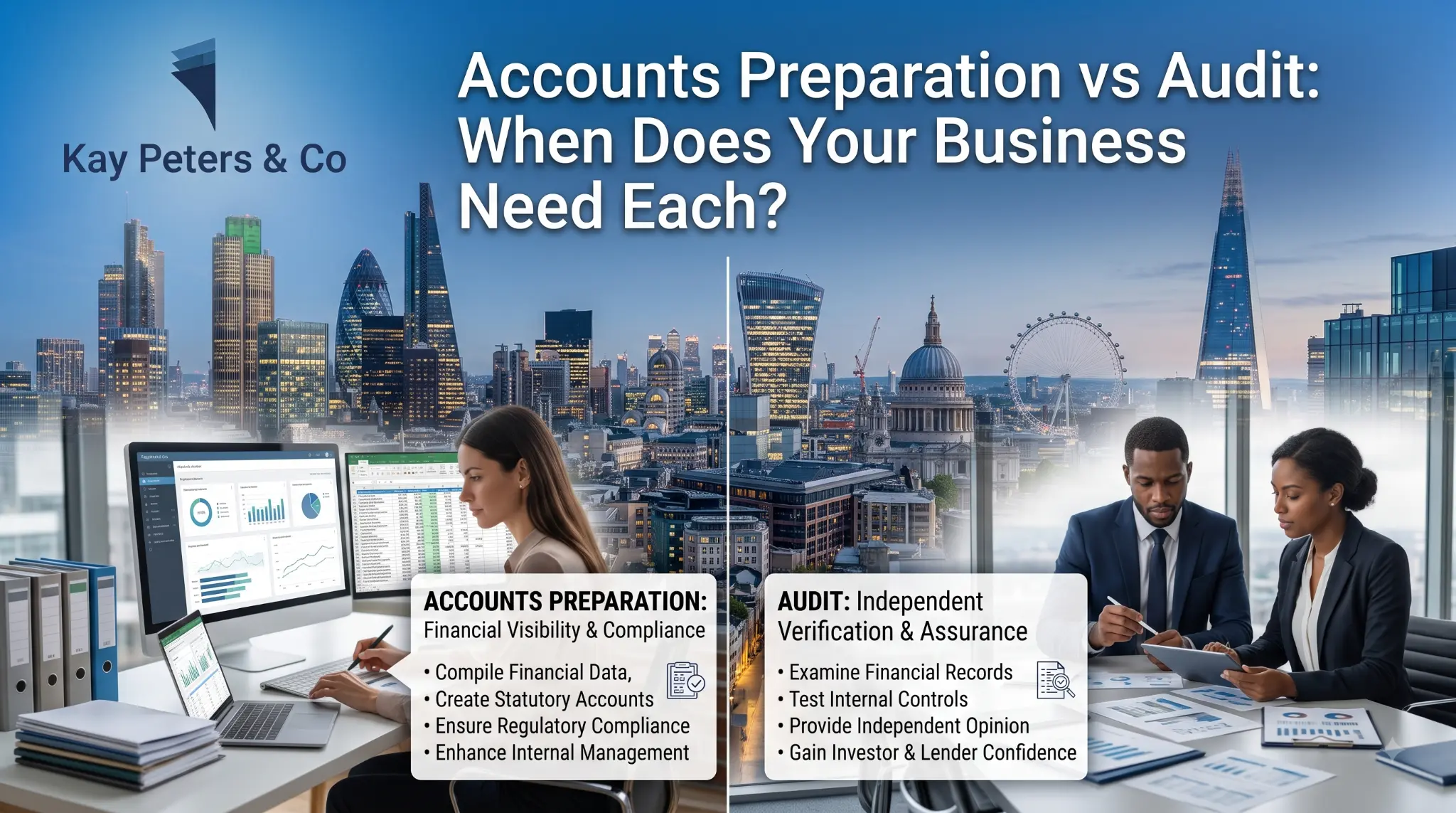
Accounts preparation (sometimes called a compilation engagement) is the process of producing statutory financial statements from your underlying records. A qualified accountant ensures the accounts comply with the Companies Act and relevant accounting standards (such as FRS 102 or FRS 105 for smaller entities).
The accountant checks that figures are correctly extracted and presented, but does not provide an independent opinion on whether the accounts give a true and fair view. Most small companies use this service for their annual filings.
What Is a Statutory Audit?
An audit is an independent examination of the financial statements by a registered auditor. The auditor gathers evidence, tests controls and transactions, and issues a formal opinion on whether the accounts present a true and fair view.
Audits are regulated and must follow International Standards on Auditing. The process is more rigorous and therefore more costly than accounts preparation alone.
Current UK Audit Exemption Thresholds
For financial years beginning on or after 6 April 2025, a private limited company generally qualifies for audit exemption if it meets at least two of the following three conditions:
- Annual turnover of no more than £15 million
- Balance sheet total of no more than £7.5 million
- Average of no more than 50 employees
(The previous lower thresholds applied to earlier periods.) Even if size criteria are met, an audit may still be required if shareholders holding at least 10% of the shares request one, or if the company falls into certain regulated categories.
When Accounts Preparation Alone Is Sufficient
Most small and micro companies can file unaudited accounts prepared by their accountant. This is appropriate when:
- The company stays within the size thresholds
- There is no shareholder request for an audit
- Banks, investors or contracts do not specifically require audited figures
- Directors are comfortable with the level of assurance provided by professional preparation
When an Audit Is Required or Advisable
A statutory audit becomes mandatory once the company exceeds the size thresholds for two consecutive years (or falls into certain public or regulated categories).
Voluntary audits are often chosen when:
- Raising investment or preparing for a sale
- Bidding for larger contracts that demand audited accounts
- Strengthening internal controls and governance
- Satisfying lender covenants
How the Two Services Work Together
Many firms prepare the draft accounts first and then, if an audit is needed, the registered auditor examines those statements. Accounts preparation creates the foundation; the audit provides independent verification. Growing London businesses frequently move from preparation only to full audit as they scale.
Conclusion:
Accounts preparation ensures accurate, compliant financial statements for filing and tax. An audit adds independent assurance and becomes necessary once size thresholds are crossed or stakeholders demand it. Understanding the distinction allows London businesses to meet obligations efficiently and plan ahead as they grow.
Ready to Clarify Your Reporting Requirements?
Contact Kay Peters & Co. today at 8 Domingo St, London EC1Y 0TA, or through our website to book a consultation and position your venture for long term success. As Chartered Certified Accountants and Registered Auditors based in Central London, we handle both accounts preparation and statutory audits with clear, practical advice. Visit kaypeters.co.uk to get started.
FAQ
Not sure which service applies to you? These answers address the most common questions.
Do all limited companies need an audit?
›
What are the current audit exemption thresholds?
›
Can shareholders force an audit even if the company is small?
›
Is accounts preparation the same as bookkeeping?
›
How can Kay Peters & Co. help?
›
Disclaimer
The information in this article represents the best interpretation and analysis of data and facts at the date it was published. However, it is of a generic nature and cannot constitute advice. Specific advice should be sought before any action is taken. If you would like to discuss how this applies to you, we are available to talk to you. Please make contact using the contact form on the company’s website.