

Providing benefits such as company cars, private medical insurance, or expense reimbursements to employees can boost morale, but it also creates important reporting obligations for employers. Missing the P11D deadline often leads to penalties and compliance headaches. Understanding P11D and P11D(b) forms is essential for London businesses aiming to stay on the right side of HMRC rules while optimising tax efficiency in 2026.
Key Areas We Will Cover:
- What P11D and P11D(b) forms are and how they differ
- Who needs to submit them and why
- Common benefits and expenses that must be reported
- Deadlines and penalties for 2026
- How to prepare and submit accurately
- Upcoming changes to benefits reporting
- How a chartered accountant can simplify the process
Introduction:
P11D and P11D(b) forms are key HMRC documents that UK employers use to report benefits in kind and expenses provided to employees and directors. In London’s dynamic business environment, where perks are common, accurate completion of these forms ensures compliance, avoids fines, and supports effective financial planning. This guide explains everything businesses need to know for the 2025 to 2026 tax year.
What Is a P11D Form?
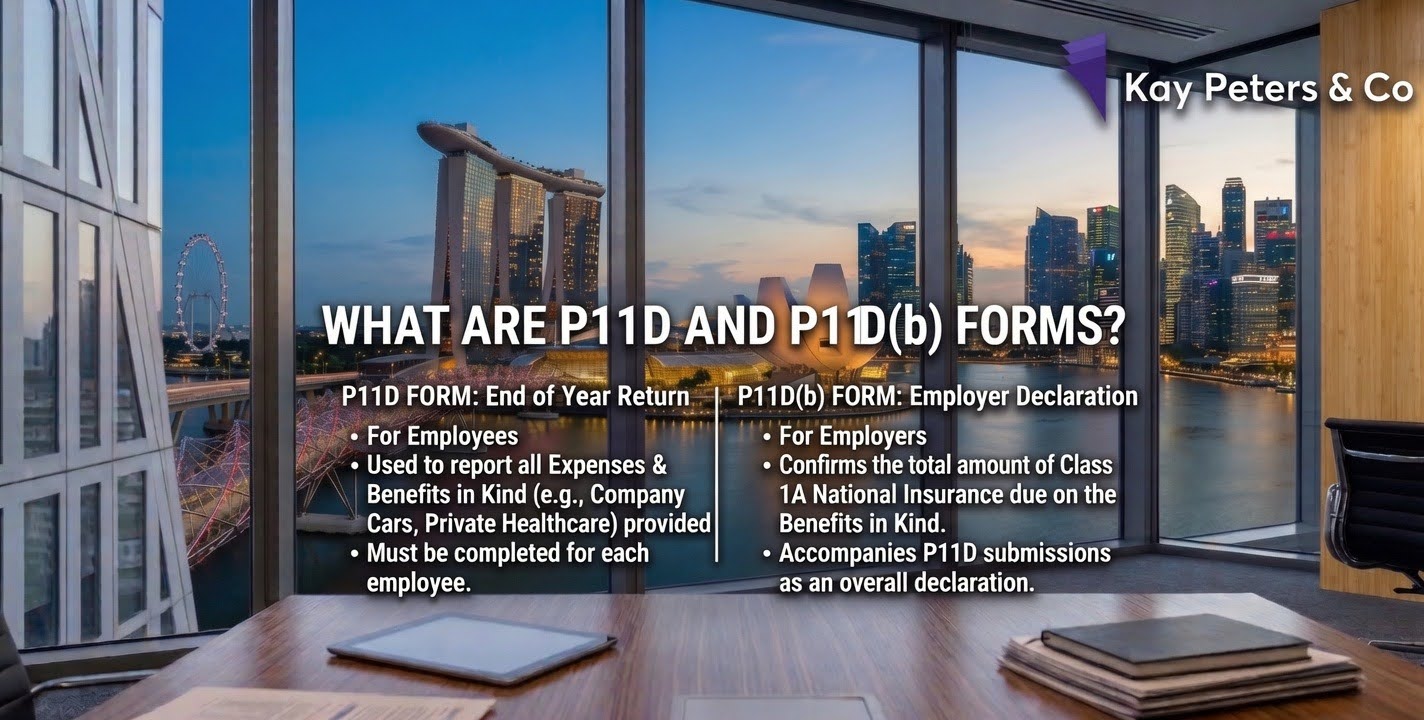
A P11D form reports taxable benefits and expenses given to individual employees or directors that have not been processed through payroll. These include company cars, private healthcare, interest-free loans, and certain mileage allowances. Employers must provide a copy to the employee and submit details to HMRC.
What Is a P11D(b) Form?
The P11D(b) is a summary declaration completed by the employer. It calculates and reports the total Class 1A National Insurance contributions due on all taxable benefits provided during the year. It covers both P11D-reported benefits and any that were payrolled.
Key Differences Between P11D and P11D(b)
- P11D: Focuses on individual employee benefits (one form per relevant person).
- P11D(b): Employer-level summary for Class 1A National Insurance (one form per employer). Both forms work together to ensure correct taxation and National Insurance payments.
Who Needs to Submit These Forms?
Any employer who provided taxable benefits or expenses not fully handled through payroll must submit them. This includes London businesses of all sizes, from startups offering flexible perks to established firms with director benefits. Even if you payroll some benefits, a P11D(b) is usually still required.
Common Reportable Benefits and Expenses
- Company vehicles and fuel
- Private medical or dental insurance
- Accommodation or relocation costs
- Low-interest or interest-free loans
- Entertainment and subscriptions
- Professional fees and gym memberships
Accurate record-keeping throughout the year is vital for correct valuation.
Deadlines and Penalties in 2026
For the 2025/26 tax year, both P11D and P11D(b) forms must be submitted by 6 July 2026. Employers must also provide copies of P11D information to employees by the same date. Late filing incurs automatic penalties (often £100 per 50 employees per month), while inaccuracies can lead to further charges and increased scrutiny.
How to Prepare and Submit P11D Forms
Maintain detailed records of all benefits provided. Use HMRC’s PAYE Online service for submission. Many businesses benefit from specialist software or professional support to ensure valuations are correct and submissions are error-free.
Upcoming Changes to Benefits Reporting
From April 2027, mandatory payrolling of most benefits in kind will be phased in, reducing reliance on traditional P11D forms. For 2025/26 and the immediate years ahead, full compliance with P11D and P11D(b) remains essential. Proactive preparation now positions your business well for these reforms.
Why Professional Support Matters for London Businesses
Navigating P11D requirements can be time-consuming and complex, particularly with director benefits or mixed payroll arrangements. A chartered accountant ensures accurate reporting, identifies tax-efficient opportunities, and minimises compliance risks.
Conclusion:
P11D and P11D(b) forms play a crucial role in reporting employee benefits and managing associated National Insurance liabilities. Staying compliant protects your business from penalties and supports smoother financial operations, especially in a competitive city like London.
Ready to Simplify Your P11D Compliance?
Contact Kay Peters & Co. today at 8 Domingo St, London EC1Y 0TA, or through our website to book a consultation and position your venture for long term success. Our team of Chartered Certified Accountants in Central London provides expert guidance on benefits reporting, payroll, and strategic tax planning. Visit kaypeters.co.uk to get started.
FAQ
Have lingering questions about P11D forms? The answers below address the most common concerns.
What is the main purpose of a P11D form?
›
Do I need to submit a P11D(b) if I have no P11Ds?
›
What happens if I miss the 6 July deadline?
›
Are P11D forms changing in 2026?
›
How can Kay Peters & Co. help with P11D forms?
›
Disclaimer
The information in this article represents the best interpretation and analysis of data and facts at the date it was published. However, it is of a generic nature and cannot constitute advice. Specific advice should be sought before any action is taken. If you would like to discuss how this applies to you, we are available to talk to you. Please make contact using the contact form on the company’s website.